Leaving the Bubble - AI in Higher Education
by Marcus Birkenkrahe
This is the text of a lunch talk given at Kiwanis Club in Batesville, Arkansas, on September 26, 2025, by kind invitation of Bryan Norris.
I want to briefly talk about three things today: The state of higher education, the impact of AI on it, and what we can do about that.
On the state of higher education
There is a famous painting attributed to the medieval Dutch artist Hieronymus Bosch, called “The concert in the egg” from the year 1561. You see a group of singers and musicians inside a giant cracked open egg. One of them is a fool with a fool’s cap, and a thief steals the choirmaster’s purse without him noticing it. In one corner, a fish is coveted by a cat - a symbol of Christ (and reason) even amid the chaos.
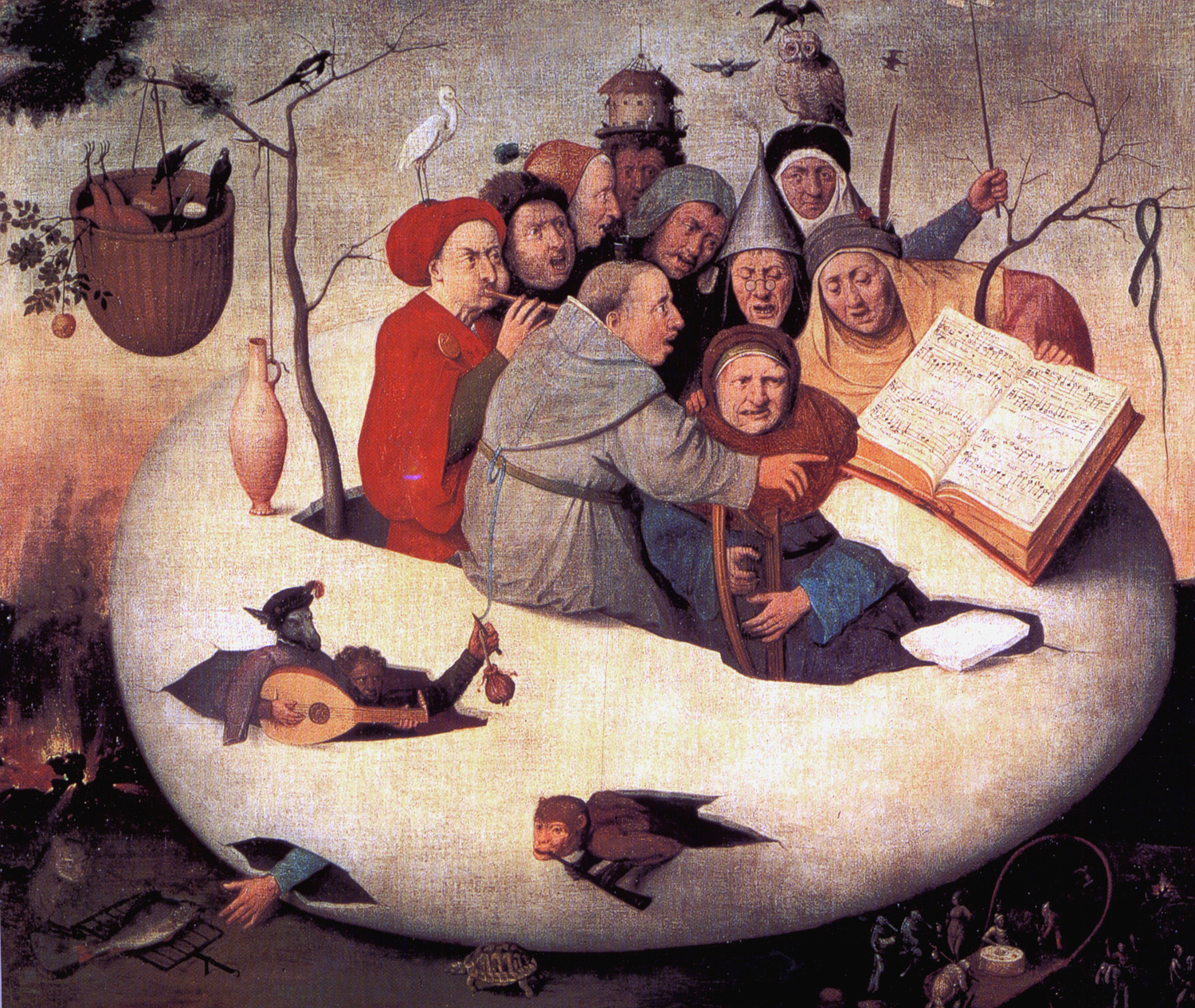
As always with paintings, you are free to interpret it as you wish. An interpretation that is in line with Bosch usual style is the following: The world is fragile like an egg, humans waste their time in foolish pleasures masquerading as art, and all are blind to sin.
I often think of this painting when I think of higher education. It is a fool’s errand alright:
-
Education is standardized like a group of goose-stepping German soldiers even though we recognize that no two people learn alike, and that no type of teaching can reach everyone in the same way. This is called “academic fairness”.

-
Society and parents entrust their children, their greatest treasure, the very future of the world, to a group of experts, the teachers, but they don’t pay them very well, and they don’t control them, or what they teach, very much - that’s called “academic freedom”.
-
Lastly, higher education is married to science in complicated ways - it’s supposed to be based on evidence and scholarly work, and faculty is also supposed to be doing research. But progress in science, if it happens at all, is painful and slow, and bound to truth, while the world requires fast, decisive action, bound to results. You might call it “academic fortitude”.
Viewed as a “concert in the egg”, as a ship of fools, academic fairness, academic freedom, and academic fortitude don’t sound so great any more all of a sudden, do they?
But of course, Bosch painted the dark side. There is another way to look at its symbolism: An egg is also a symbol of life, potential, and rebirth. And that’s what I really see in education: It may look chaotic, cracked and cacophonous from the outside, but inside, there is the chance for new life, new ideas, and transformation. Kiwanis may understand this better than most, because you invest in young people.
What I’ve just done is used the same image but changed it so that my initial assessment, ironic and depressing, is turned on its head. This technique, re-framing, and it is a key ingredient to teach people critical thinking but also to make yourself feel better of course, when you’re feeling blue and need a pep talk.
I re-framed the image because I do believe in teaching and learning but I don’t think, especially in these trying times, it should be taken for granted, or automatically given free reign.
Let’s look at these three pillars of academia again:
-
Academic fairness is not just uniformity and slavishly obeying mindless rules. It contains a high value: Everybody deserves a chance, because we were all made in God’s image, with untapped potential. The standard is a concession to cost, and to the need to measure outcome - but on the ground, the fight for knowledge is carried out mano a mano, eye to eye, and heart to heart.
-
Academic freedom is based on trust in teachers. It is far from being automatic - it has to be earned, and even if institutional controls may be missing, it is destroyed easily. This is not so different from leading a team - every time I come to class, I need to justify that trust. That’s a lot of pressure actually, since teaching is very much also a performance, but even more I see it as a privilege. The more freedom I am given, the more responsibility I feel to justify that space. To be paid, no matter how much really, as long as it is enough to live on, for teaching other humans, is an enormous gift.
-
Academic fortitude is not just scientific method and scientific speed. It is above all a commitment to truth through evidence and logic. This is not a light burden because truth is always attacked by the Devil, as we are attacked by him. So we fail, and we lie, and we fail again, and we lie again - but we don’t give up. In actual fact, science is under attack both from within and from without.
So perhaps we’re not in a concert in an egg, after all. Maybe we’re at a rehearsal — it’s noisy, imperfect, and sometimes out of tune. But when the concert begins, it can be beautiful. There’s hope.
The impact of AI on higher education
Enter so-called “Artificial Intelligence”. Lots of air quotes here - the makers of this technology have flooded the market with empty promises, most notably about the end of human labor due to a friendly takeover by AI.
Education has not been spared: This is less because of proven ability of AI to replace teachers, or to satisfy and motivate students better than any living person every could, but because of the already mentioned three pillars of academia: fairness, freedom, and fortitude.
For example, many people think that machines are more fair. This is a fallacy: Machines are as fair and unbiased as the people who program them, since they don’t think for themselves. The only thing you achieve if you transfer processes requiring fairness to a machine is another layer of abstraction, another layer of red tape you have to cut through if you have a problem.
What about academic freedom? It’s an expensive good, and if we want everybody to have as good an education as possible, it’s going to cost more and more, so automation seems to be the way forward in education. Or if not automation, then at least augmentation: Let’s give each student their own super-informed, super-intelligent AI tutor. No more noisy classes stuffed with resistant students who’d rather spend another hour on their phones than having to learn math, or other things that older people think they ought to learn.
This is an even more persistent, dangerous delusion: To replace a thinking, feeling human teacher by a machine is like replacing your loving, loyal dog by a fence post that beeps when you approach it. It reduces the proven process of teaching and learning that has brought us this civilization by a speculative notion of human-computer interaction, as if successful teaching could actually be designed and programmed as a whole, and not just in parts.
Lastly, academic fortitude: science and research done by machines instead of by humans, or with humans. I’ve just written a paper on this topic, so I could go on for a while, but perhaps just the tagline: Academic fortitude, academic rigor, the finding and the defense of truth depends, above all, on telling the truth, which these machines we are talking about, large language models that deliver generative AI, are principally incapable of delivering. They are, by their very nature, condemned to lie to us some of the time, and worse, without any way of knowing when that will be. And even worse, without any hope for us (for now anyway) to look into their internal organs and find the origin and the reason for their lies, otherwise called “hallucinations” or “confabulations”. But you can just as well call them errors or bugs.
In these three scenarios, machines don’t just replace humans in education, they make it better! I have tried to indicate that I think a lot of it is snake-oil, but even more of it is human hope to bring peace and harmony to the messy business of education. It’s not the machines fault, it’s our fault for being conceited.
What we are doing about it
The current battle that is brewing between humanity and AI has three frontiers: Automation, augmentation, and assessment.
We don’t have time today to go into all of these. I am bound to talk to Bryan Norris here next week on his podcast about AI’s potential for automation in bureaucratic processes, so stay tuned. Augmentation, on the other hand is proceeding at a rapid pace: Every time an AI tool is integrated in a search engine or in an app on your phone, you’re being augmented, and there’s little you can do about it short of living among the Amish.
What you can do is inform yourself, listen carefully, and not believe what every expert says. This includes me, of course! And this is where Lyon College is hoping to make its mark. We have made some important changes:
We have added four new majors in computer and data science, including two programs focused on artificial intelligence (CS and AI, DS and AI), as well as a program on cybersecurity and on game development. In the industry, both of these are heavily impacted by AI.
At Lyon College we have given ourselves broad generative AI guidelines, for faculty, staff and students - all of us in the egg. These guidelines are based on research that we carried out at the college with undergraduate researchers. They cover transparency, data protection, and ethical use. We provide sample syllabus language for five different AI scenarios in the classroom, from “Absolutely No AI” to “Full AI Integration”, and appropriate uses of AI for administrative work. These guidelines were worked out by a group of eight members of faculty and staff, and we are fully aware that they’ll have to be adapted as AI use in education changes.
Conclusions
In closing, let me briefly summarize:
- Higher education rests on three pillars - fairness, freedom, and fortitude. All three are challenged by the rise of generative AI.
- AI promises efficiency, but it adds bureaucracy, threatens trust, and cannot guarantee truth.
- The real work of education remains human: fairness is personal, freedom is earned, and fortitude is perseverance for truth.
- Lyon College is preparing for the coming storm by new programs and guidelines, but the larger responsibility is to stay informed, skeptical, and hopeful.