What am I actually doing in class?
by Marcus Birkenkrahe
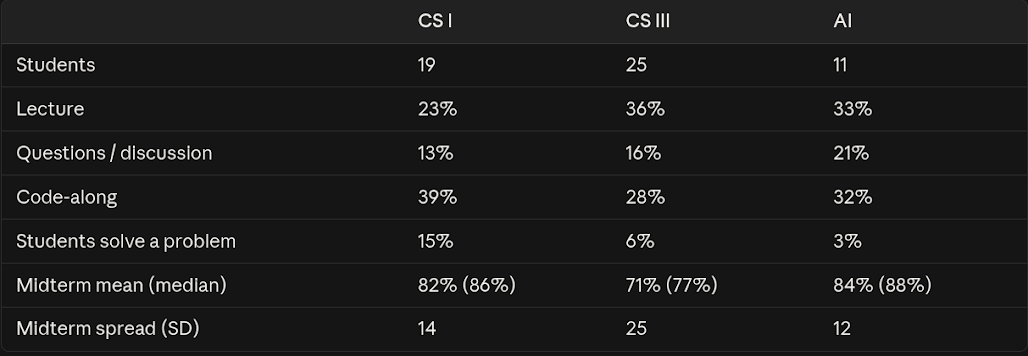
What am I actually doing in my classes, as opposed to what I want to do? My ambition has always been at most 30% lecture, at least 50% student activity (coding along, solving problems, questions and discussion), and at most 20% admin - announcements, and solving computer and access problems, which are frequent in computer science classes. But I was afraid that I might be deluding myself.
So I checked. All my class sessions up to the midterm were recorded with Google Meet, which produces a transcript. I asked AI (Claude) to label every five-minute block of the 49 transcripts in my three courses - Computer Science I (CS I, with Python), Computer Science III (CS III, with Java) and Artificial Intelligence (AI, with Python) - as lecture, questions and discussion, code-along, students solving a problem, or admin. The table shows the result, next to class size and midterm results. No student names or individual grades went into it, only averages.
The verdict is better than I feared:
- Students are active at least half the time in all three courses: 67% in CS I, 50% in CS III and 56% in AI (coding along, solving problems, questions and discussion).
- Admin stays at 11-14% everywhere. Most of it is solving individual students’ problems at their laptops.
- The one miss: in CS III and AI, I lecture a little more than planned (36% and 33%). And there, students rarely solve problems on their own (6% and 3%); most of their activity is coding along with me and discussion.
- CS I hits all three targets, with 23% lecture.
It pleases me that CS I looks the best, because this is where students need the most practice in class. For the other two courses, the numbers give me a clear target for the second half of the term: fewer minutes of me talking, more minutes of students solving problems.
The midterm results are not conclusive. With only three classes, any correlation would be chance, and the exams differ in subject, level and question types. The smallest class, with the least practice (AI, an upper-level elective), scored highest. The largest class, with the most lecture (CS III), scored lowest and had the widest spread.
Limitations:
- The classroom has one microphone, so the transcript attributes everything to me, including what students say. The AI had to infer the activity from the content.
- The AI labeled each block from samples of its text (beginning, middle and end), so take the percentages as plus or minus five points.
- “Code-along” includes stretches where students watched me code rather than typed along, especially in CS III.
Lots more questions to ask here. The one I want to try next: what do my students think happens in class? What amazes me most is that I can ask such questions at all: about 50 hours of class, 372,000 words of transcript, analyzed in about 20 minutes from question to table. Without AI, I would never have attempted this - certainly not in the middle of a term.